Press "Enter" to skip to content

Tag: Gandy Dancer

The Importance of Literary Citizenship

Posted by Klarisa Loft, Fiction Reader for issue 4.2

6d28c698-7bc7-47b5-b22b-6e3d1a063a69

As a student who is currently taking a senior seminar in creative writing as well as the editing and production workshop in which we create Gandy Dancer, I’ve been hearing a lot of discussion on what it means to be a literary citizen. I feel like this is an important topic to tackle outside the classroom as well. The literary community is a small one, especially in a modern world where the study of humanities is confusing to many since it doesn’t lead to a particular job.

In other words, we need all the support we can get.

This is where that literary citizenship comes into play. Writers have our love of reading and writing in common, so how about we fuel each other with that positivity? Don’t lurk in the literary shadows. Come out. Attend readings near you; help promote your friends’ literary accomplishments through social media. Subscribe to a literary journal you enjoy. Buy books! And when you read something you truly like, let that writer know. Every writer deals with a fair amount of rejection; it comes with the territory. But, as accustomed to it as someone might be, it never hurts to know that there are people out there who genuinely like and believe in our work. This is what spurs us to keep going. In her book Making A Literary Life, Carolyn See suggests writing charming notes to the writers whose work you enjoy and appreciate. She says that a notecard is all you really need for this; it takes a few seconds and has to power to drastically improve someone’s writing confidence.

Comments closed

Why Reading a Book Can Be Better Than a Movie

Posted by Jeanna Foti, Fiction Reader for issue 4.2

My roommate once told me, “I’d rather watch a movie than read a book.” And immediately I thought, really?! A book has so much more to offer than a movie does. But I know mine isn’t the popular opinion. Everyone these days seems to have a cell phone and it’s hard to find a college student who doesn’t own a laptop. In a world where every college student seems to have a Netflix account, literature has been pushed to the side and forgotten.

While Netflix has made it easier to binge watch a TV series, there is still something about literature that, in my opinion, can be even greater than a TV show. When reading a book, you create a little universe inside your mind using just the words on the page. It’s an experience unique to you. You’re using your imagination to picture the story you are reading and taking an active role in creating it. This aspect is one of the things I love about reading; it allows you as the reader to have a say in how you see the story.

Comments closed

What We’re Reading: The Opposite of Loneliness

Posted by Meaghan Johnston, CNF Reader for Issue 4.1

The Opposite of Loneliness is a collection of essays written by Marina Keegan, a writer who died five days after her graduation from Yale, at the young age of twenty-two. I would assume that as a young writer, Keegan didn’t write her essays knowing they would become a New York Times best seller. She wrote for the same reason that many of us do – to attempt to make something of the world around us, to attempt to make something of ourselves. Keegan’s writing speaks of what it means to be a writer, as well as what it means to be human.

Comments closed

Sleep, Dream, Write: The Writer’s Routine

Posted by Oliver Diaz, Former Contributor and Fiction Reader for Issue 4.1

The truth is writers (besides Stephen King) cannot survive on writing alone due to their limited ability to pump out a plethora of valuable literary works, and ultimately, the meager financial compensation. When a writer has another job, another commitment, another pot on the stove, writing takes the back burner. As a student, I rearrange reading, writing papers, and going to class on my stovetop, and writing remains relegated to the back of the stove. Why? Well, my schedule tells me when to show up for class, and when to leave. I have to do my work before class, so although the time frame is not exact, it is narrowed. If writers don’t decide (and yes, the responsibility is on us) on a timeframe to sit down and write, how can we expect ourselves to show up?

The writer’s most feared question is, “Have you been writing lately?” Often the response is, “I will once I find the time,” or “I’m going to find time this weekend.” Well, one day I found myself on the receiving end of this question and took the predicted way out. The inquiring artist looked at me with a knowing stare, and said, “We don’t find time, we make time.” Of course, I thought to myself, time is not hiding around corners, behind bushes, or at the bottom of the laundry basket, I am making time, as in “Sure, I can make time for that.”

Comments closed

The War on Math

Posted by Melanie Weissman, CNF Reader and Art Curator for Issue 4.1

“I’m not a math person.”

It’s a statement we’ve all probably heard, if not spoken, multiple times throughout our lives. The sentiment seems ubiquitous among literary types like me. Why is that?

Numerous sources claim that the idea of some people being more inclined to natural mathematical talent than others is a lie and anyone can be a math person if he would just quit whining and put some effort into his studies already. I’m far from an expert on the workings of the human brain, so I’m in no position to contest that, but I can say that in my personal experience, when I’ve said that I wasn’t a math person, I haven’t merely been stating that I found math harder than other academic subjects (though I certainly do); I’ve also been expressing that I just plain don’t like math.

blog imageI guess that’s not entirely true; I do enjoy math in some capacities. I’m a big fan of Sudoku and those logic puzzles where you have to figure out who drives which car or who saw which movie. Even the less glamorous parts of math, the geometry and trigonometry and calculus, aren’t the absolute worst things in the world. (Algebra is pretty bad, though. Algebra can die in a fiery pit.) I suppose I’d rather find a derivative than clean my room. Rationally speaking, I know I shouldn’t have that much of a problem (if you’ll excuse the pun) with math, so why do I often feel the need to tell people those dreaded five words: “I’m not a math person”?

Comments closed

New Kids on the Block: Meet Your Managing Editors for 4.2!

Have no fear, your new managing editors are here! As the spring semester murmurs to life and the windy Geneseo weather welcomes us all back it’s time for your new managing editors, Courtney and Christy (C2), to sit down with some coffee and ask each other the questions that matter:

Let’s get this party started:

The Dream Team: Ready for Action!

How did you first get involved with Gandy Dancer?

Courtney: One of my friends recommended the class to me, actually. I was looking at courses for junior year and wanted to know more about it. My friend was in the class at the time and told me about how it was a really hands-on class where you got to put together a literary magazine full of prose, poetry, and visual art from students all across the SUNY system. The publishing industry is so multifaceted and is something that has always intrigued me as well so I decided to give it a go. I’m so glad I did though because I fell in love with everything about Gandy Dancer (GD) and kept coming back to it. As an avid reader and writer, being involved in this class has exposed me to so many fascinating aspects of the literary world that I never knew about before GD.

Christy: In the middle of my junior year I was perusing the course list on KnightWeb in a sleep-deprived-registration-is-tomorrow-morning-frenzy when I happened upon this gem of a class. I, somewhat nervously mostly excitedly, decided to sign up and I’m so glad that I did because it ended up being an incredible experience. At the start of the class I knew virtually nothing about literary magazines, literary magazine culture, or how they functioned and survived. It was, not to quote Aladdin, a whole new world! Not only did it widen my horizons within the creative writing/literary universe but also getting to read through and edit submissions from other young writers really helped me to grow as a writer and as a poet. I’m so excited to be back!

Comments closed

The Common: A Lit Journal for a Modern Audience

Posted by Demetria Monachino, Fiction Reader and Art Curator for Issue 4.1

Before working on the Gandy Dancer, I didn’t know what a literary journal was. I didn’t know that there were publications out there dedicated to collecting individual works by writers and artists. I just sort of thought that one wrote a book–a novel, a collection of short stories or poems, a memoir–sent it to publishing houses, and got lucky. I knew that some people wrote short stories, essays, and poems, but I didn’t know where those works went, where they belonged, if not in a book.

It turns out that these pieces of literature find their homes in literary journals all over the world, one of which is The Common. Based in Amherst, Massachusetts, The Common has a rather uncommon goal: to achieve “a modern sense of place.” Unique to the world of literary journals, The Common is all about location, location, location.

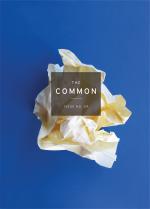
common-9Upon first look, The Common has a striking appearance. Its readers know that when the receive their issues they can expect a minimalist, modern, and clean-looking journal that features a bold color and a “common” object on the cover, along with The Common’s signature square logo. What readers can’t predict is what exactly that eye-catching color and everyday object will be. I find that The Common’s consistent yet unpredictable approach to the appearance of their journal mimics what can be found in the pages of the journal. Yes, readers can expect to read and view pieces with a strong sense of place, but they can never know what those places will be. Just as there are endless objects in the world to choose from, there are endless places to write about. These places could be geographical, like Issue 9’s portfolio of works centered on Bombay/Mumbai, or local, like Issue 7’s “Your Parent’s House” by Zeina Hashem Beck. Or place might provide the conflict by separating two people as it does in Masha Hamilton’s “God’s Fingernail,” in Issue 9. It could even be about searching for a place to belong or something to hold on to. This is the case with Issue “In Search of Bazena Nmcova” by Kelsy Parker, which I read in Issue 7.

Comments closed